
Combining Two or More Neosurf Vouchers into One Betting Deposit
 Available in US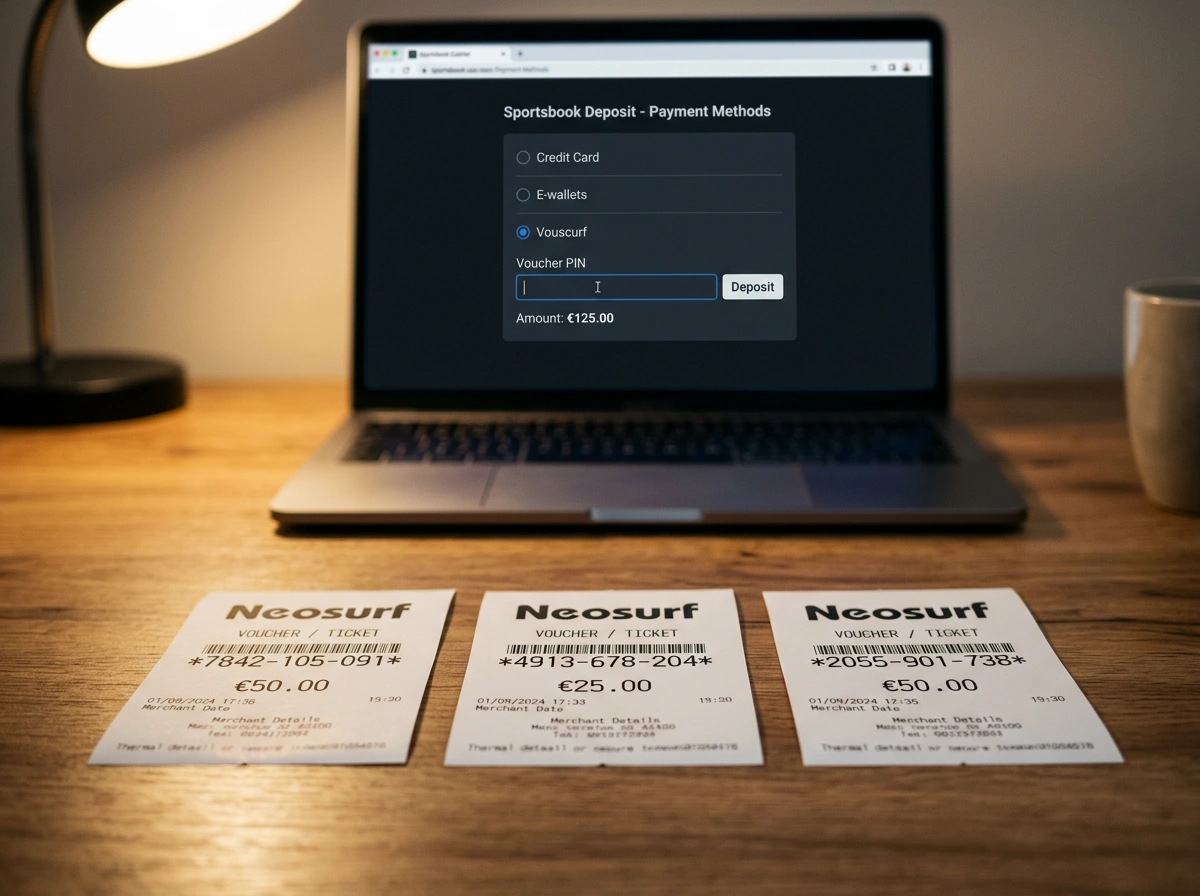
Two A$50 vouchers is not automatically A$100
A mate texted me before a Magic Round weekend: “Got two A$50 Neosurf vouchers, can I just deposit them as A$100?” The honest answer is “sort of.” The voucher face values add up mathematically, but the deposit flow doesn’t treat two vouchers as one. Each voucher gets redeemed as a separate transaction, each may trigger a separate minimum-deposit check, and some sportsbooks handle the second voucher very differently from the first. The practical mechanics of stacking vouchers are messier than the arithmetic suggests.
The reason the question comes up regularly: retail voucher denominations top out at specific tiers. If you want to deposit A$80, no single voucher matches that amount. If you want A$300, you’re either buying three A$100s, two A$150s, or some other combination. Anyone running a slightly-above-standard bankroll ends up navigating this question eventually, and the sportsbook-level variation in how multi-voucher deposits work is worth knowing before you stand at the register buying three vouchers for one weekend’s punting.
The wider context sits in our Neosurf betting guide for Australia.
Sequential redemption: the most common flow
At the majority of AU sportsbooks, combining two Neosurf vouchers means running two separate deposit transactions in sequence. Open the cashier page, enter the first PIN, confirm the deposit, wait for the balance to update, return to the cashier page, enter the second PIN, confirm again. Two transactions, two balance updates, two entries in the account’s deposit history.
This is the cleanest mechanism from a compliance perspective — each voucher is a discrete instrument, and each redemption is a discrete event. It’s also the most common workflow because it requires no special multi-voucher logic from the sportsbook. The bookmaker’s payment gateway handles Neosurf deposits one PIN at a time; the user manually does two trips through the same flow.
The friction is real but manageable. Two minutes instead of one. Two page loads. Two confirmations. Not a dealbreaker, but enough that if you’re doing this regularly, you want to make sure the retail side was worth the operational hassle of splitting. For a rare large-deposit scenario — Cup Day, Grand Final, a big derby — the two-step sequential flow is fine. For weekly use, I’d consolidate through a different approach.
myNeosurf consolidation as an alternative path
The alternative to sequential bookmaker deposits is consolidating vouchers into a myNeosurf wallet first, then making a single deposit from the wallet balance. You load voucher one into myNeosurf, load voucher two into myNeosurf, end up with a combined balance, and then send a single deposit of the combined amount to the sportsbook.
On paper, this is cleaner. One sportsbook transaction, one deposit entry, one confirmation. The problem is the cost. myNeosurf charges a 4.5% top-up fee each time you load a voucher into the wallet. Two A$50 vouchers loaded into the wallet cost you A$4.50 in fees before you’ve deposited anywhere. Whether that’s worth paying depends on what you’re trying to achieve.
For users who consolidate vouchers often — multiple times a month — the myNeosurf wallet provides genuine utility despite the fee. You maintain a persistent balance across multiple vouchers, you can deposit to any Neosurf-accepting site without tracking individual PINs, and you gain some continuity across sessions. For the broader question of when a myNeosurf wallet earns its fee versus when a single voucher is the smarter choice, a separate analysis is worth reading before committing to the wallet path for any extended period.
For users combining vouchers once or twice a year — a big race day, a one-off large deposit — the 4.5% fee is a bad trade. Sequential redemption at the sportsbook, despite the operational friction, costs nothing. Use the wallet when you’re actually using the wallet as a product; use sequential deposits when you just happen to have two vouchers this weekend.
Bookmaker-specific multi-voucher limits
Not every sportsbook allows unlimited sequential voucher redemptions. Some operators cap the number of Neosurf deposits in a day or a week, either as a fraud-prevention measure or to discourage patterns that look like structured cash-equivalent deposits. The caps are usually high enough that casual users don’t hit them — five or ten deposits per day is a typical ceiling — but they’re real and worth being aware of if you’re planning to stack four or five vouchers for a single event.
Minimum-deposit thresholds apply per-transaction, which matters if you’re combining small residuals. If a bookmaker’s Neosurf minimum is A$20 and you have a voucher with a residual balance of A$15, that second transaction will be rejected even though the combined balance-in-hand is larger than the minimum. Partial balances on vouchers below the minimum can’t be directly deposited; they need to be consolidated through a myNeosurf wallet first or abandoned.
A handful of operators run specific multi-voucher deposit forms that accept several PINs in a single transaction. This is uncommon on AU-licensed sites but shows up occasionally. The user experience is better when it’s available — one submission, one credit, one receipt — and you’ll know it’s an option because the cashier page will show a multi-PIN entry interface rather than a single-PIN field.
The cost of combining
Putting numbers on the three paths makes the choice concrete. Sequential bookmaker deposits: zero additional cost, two minutes extra time, two line items in your deposit history. myNeosurf wallet consolidation of two A$50 vouchers: A$4.50 in top-up fees, cleaner single deposit, persistent wallet balance you may or may not want. Sportsbook-native multi-voucher form (where available): zero cost, fast, single line item — the best outcome, but rare.
For users combining three or more vouchers at once, the wallet math gets steeper. Three A$50 vouchers into myNeosurf costs A$6.75 in fees. Five costs A$11.25. At those sizes the sequential-deposit path becomes increasingly attractive despite the friction, and I’d recommend it for any one-off large deposit scenario. The wallet makes more sense for ongoing use where the fee amortises across many months of convenience.
One cost-angle worth flagging: buying a single higher-denomination voucher is usually cheaper than combining two smaller ones. A single A$100 voucher costs the same A$100 at retail as two A$50s, but involves one receipt, one PIN, one transaction on the way in. If your target deposit matches an available face value — A$100, A$150, A$200 — buy one voucher of that size rather than combining smaller ones. The only reason to split is if retailer availability pushes you toward smaller denominations, or if you’re using the split as a bankroll-pacing tool.
Leftovers are a separate problem: unused voucher balance.
When one bigger voucher is better
For most punters, a single voucher matching your intended deposit amount is the cleanest path. The reasons are practical: one retail interaction, one receipt to track, one PIN to guard, one deposit transaction at the bookmaker. The multi-voucher scenarios exist because sometimes you can’t get a single matching denomination, or you’re topping up an existing balance from an earlier partial use.
If you regularly find yourself combining vouchers — say, three or four times a month — that pattern itself is worth examining. Either your target deposit amounts aren’t matching available face values (in which case, consider rounding to a matching tier), or you’re making frequent small deposits in ways that might benefit from a wallet product (in which case, myNeosurf starts to pay its fee). A weekly habit of buying two A$20 vouchers instead of one A$50 suggests either indecision about deposit size or an intentional pacing strategy — worth being honest with yourself about which it is.
For the one-off big deposit — the A$300 you’re putting into a Cup bankroll, the A$200 for an Origin weekend — three A$100 vouchers bought one after the other at a single trusted retailer is the most reliable path. Deposit them sequentially when you get home, don’t pay wallet fees, accept the two extra minutes of cashier-page time. Boring, reliable, zero-surprises.
Can I redeem three Neosurf vouchers in a single checkout at an AU sportsbook?
At most licensed AU sportsbooks, no — each voucher is redeemed as a separate transaction in the cashier flow. A small number of operators offer a multi-PIN deposit form that accepts several vouchers in one submission, but it’s uncommon. The standard path is sequential redemption, one PIN at a time, across three separate deposit transactions.
Is it cheaper to consolidate vouchers via myNeosurf before depositing?
Usually not, because myNeosurf charges a 4.5% top-up fee for each voucher loaded into the wallet. Two A$50 vouchers cost A$4.50 in fees through the wallet, while sequential bookmaker deposits cost nothing. The wallet makes sense for ongoing consolidation of many vouchers over time, not for one-off combinations.
