
myNeosurf Account vs Single Voucher: Which Fits AU Punters
 Available in US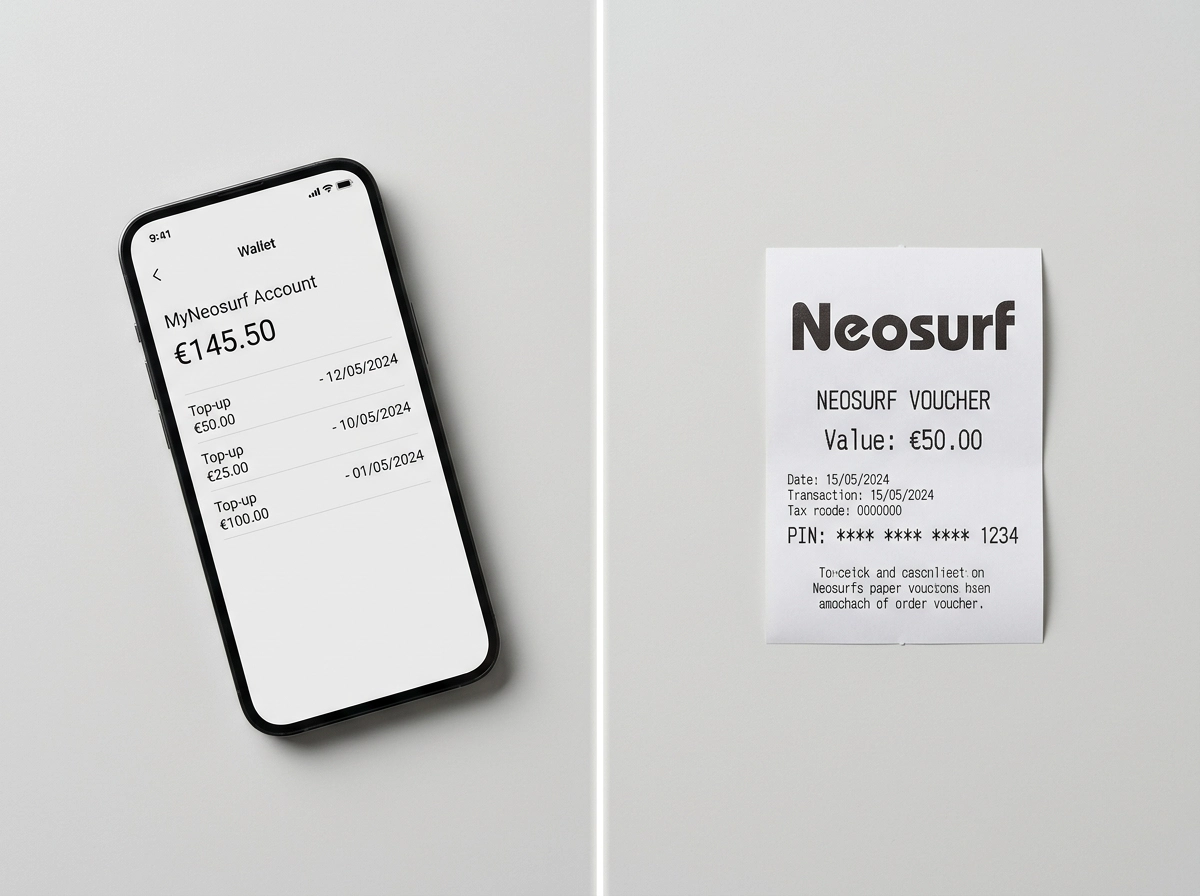
Same brand, two very different products
Most users I talk with don’t realise Neosurf actually ships two different things. There’s the single-use voucher — the paper receipt with a 10-digit PIN that most AU punters mean when they say “Neosurf”. And there’s myNeosurf, a persistent digital wallet that sits on top of the voucher rail and lets you load, hold, and spend balance across multiple sites from a central account. They share a brand and a logo. They are otherwise completely different products with different economics.
Choosing between them isn’t a style preference. It’s a cost calculation weighted against how often you bet, how many sportsbooks you use, and whether you value operational simplicity or consolidation. Neither product is universally better. The answer depends entirely on your actual betting behaviour, and I’ll walk through the specific scenarios where each one earns its keep.
The wider context sits in our Neosurf betting guide for Australia.
What myNeosurf adds on top of the voucher
myNeosurf is a digital wallet with a balance that persists across sessions. You load it from vouchers (buying from retail), from certain bank transfers, or through top-ups from other Neosurf products. Once loaded, the balance sits in the wallet until you spend it at any Neosurf-accepting site. You don’t need a fresh voucher each time; you just enter your myNeosurf login and specify the amount to send.
The practical benefits are consolidation and flexibility. Instead of holding four unused vouchers at different face values, you hold one balance. Instead of running to the newsagent before every deposit, you’ve already pre-funded the wallet and can move money to a bookmaker in twenty seconds from the phone. For multi-operator users, myNeosurf also becomes the consolidation point for betting across two or three sportsbooks without re-entering card details at each one.
The wallet also links to the Neocash Mastercard product for users who want a physical or virtual card spending format. And it handles partial-voucher balances cleanly — load the leftover A$20 from a partially-used A$50 voucher into the wallet and it stops being an orphaned remainder. That last use case is actually one of the cleanest fits for myNeosurf, and for users who routinely end sessions with unused voucher remnants, the wallet quietly solves a real problem that single-voucher workflows leave unresolved.
The cost of persistence
Everything myNeosurf adds comes at a fee. The 4.5% voucher-to-wallet load is the headline number. Every A$100 of voucher becomes A$95.50 of wallet balance. On an A$50 monthly load, that’s A$2.25 a month in load fees — not ruinous, but real, and compounding if you load multiple times.
The 1.5% bank-withdrawal fee on the other side means balance doesn’t round-trip freely. If you load A$100, don’t use it, and want to pull it back to your bank, you’d pay A$4.50 in load fees going in and A$1.50 in withdrawal fees going out — A$6 of friction on a break-even journey. That discourages treating myNeosurf as general savings.
A useful way to frame the cost: the wallet makes sense when the convenience of consolidation is worth at least 4.5% of the balance you’d otherwise move as single vouchers. For a punter depositing A$30 a month at one bookmaker, that’s A$1.35 in fees to save roughly one retail trip — not usually worth it. For a punter depositing A$200 across three sportsbooks, that’s A$9 to save three retail trips and three separate voucher-management decisions — often worth it.
The occasional versus frequent punter cut
The cleanest decision rule I use: single-voucher if you bet once or twice a month at the same one or two operators. myNeosurf if you bet four or more times a month, or at three or more operators, or both.
An occasional punter — the Melbourne Cup once-a-year, State of Origin three times, maybe an AFL Grand Final Saturday — has essentially zero need for myNeosurf. The voucher cost isn’t the issue. The issue is that the wallet charges you for persistence you don’t use, and the complexity of an extra account and password to manage isn’t compensated by any operational benefit. Single voucher every time is the right call.
A regular weekly punter, especially one who spreads bets across multiple operators for best-odds shopping, looks very different. Retail trips every few days become tedious, and the fees start to look like a reasonable trade for not having to plan voucher purchases around sportsbook deposit events. For this group, myNeosurf earns its keep, though some users still prefer the friction of the voucher trip as a built-in pacing mechanism.
A heavy daily punter is an edge case worth naming separately. At that volume, the 4.5% load fee becomes meaningful in absolute terms — A$500 a month in voucher loads costs A$22.50 a month in myNeosurf fees — and at that intensity the user should probably be evaluating whether Neosurf is the right rail at all, rather than optimising within it.
Security and account access differences
The security profiles of the two products are genuinely different. A single voucher is a bearer instrument — the PIN is the money, and whoever types it in first owns the balance. Security is entirely about protecting the receipt until deposit. A myNeosurf account is a credentialed identity — you log in with email and password (plus optional 2FA), and the balance is tied to that identity regardless of who holds any physical receipts.
Which is safer depends on how you use each. A voucher stored in a wallet and used within hours of purchase is extremely secure — very limited attack surface. A myNeosurf account with a strong password, 2FA enabled, and no credential reuse is also extremely secure. A voucher photographed and backed up to cloud storage without thinking is vulnerable. A myNeosurf account with a reused password and no 2FA, tied to an email that was compromised in an unrelated data breach, is very vulnerable.
The account-recovery model matters too. Lose a voucher receipt and recovery requires original proof of purchase, a Neosurf support ticket, and no guarantee of success. Lose access to a myNeosurf account and you go through account-recovery flows — email verification, identity checks — which are imperfect but generally more reliable than physical-receipt recovery.
The cost of each route is broken down in Neosurf fees.
The decision matrix, in practical terms
Start with frequency. Fewer than three deposits a month? Single voucher, full stop. Don’t open a myNeosurf account; the fees and complexity aren’t compensated by utility.
Three to ten deposits a month across one or two operators? The single-voucher approach still usually wins on pure economics, but myNeosurf’s consolidation value starts to matter if your retail-access situation is awkward — long drive to the nearest NAR, mismatched hours with your preferred betting times. In that case, the 4.5% fee is effectively a convenience premium you’re paying to decouple deposit timing from retail-opening hours.
Three or more operators regardless of deposit count? myNeosurf tends to win because the consolidation across sites removes management overhead. You hold one balance, deploy it wherever you want, and don’t maintain parallel voucher logistics for each operator.
The regulatory framing worth holding in mind throughout is that the wagering environment around these choices has been tightening steadily. Communications Minister Michelle Rowland framed the June 2024 credit-card ban in uncompromising terms: Australians should not be gambling with money they do not have.
The voucher-to-wallet pipeline sits inside that framework — it’s explicitly cash-origin, explicitly capped at what you actually have, and both product formats preserve that property. The choice between them is about operational fit, not about any difference in the regulatory or harm-protection posture. The precise fee breakdown across the full Neosurf product family is where the arithmetic of any decision ultimately has to be worked out.
Can I open a myNeosurf account as an Australian resident?
Yes. myNeosurf accepts AU residents as account holders, with standard identity verification applied during signup. The account operates in AUD for Australian users. Functionality mirrors the global product, with the minor difference that some Neosurf partner integrations outside AU aren’t accessible — relevant only if you’d use the account internationally.
Is myNeosurf balance linked to a BetStop registration?
No. BetStop is a wagering-operator registration that applies at the sportsbook level, preventing registered individuals from opening or funding wagering accounts with Australian licensees. It doesn’t affect your ability to hold a myNeosurf balance, which is a payments product. The friction comes when you try to send that balance to a licensed AU sportsbook — a registered BetStop user won’t be able to maintain an account to receive it.
