
Neosurf Voucher Expiry: How Long Your AU Code Stays Valid
 Available in US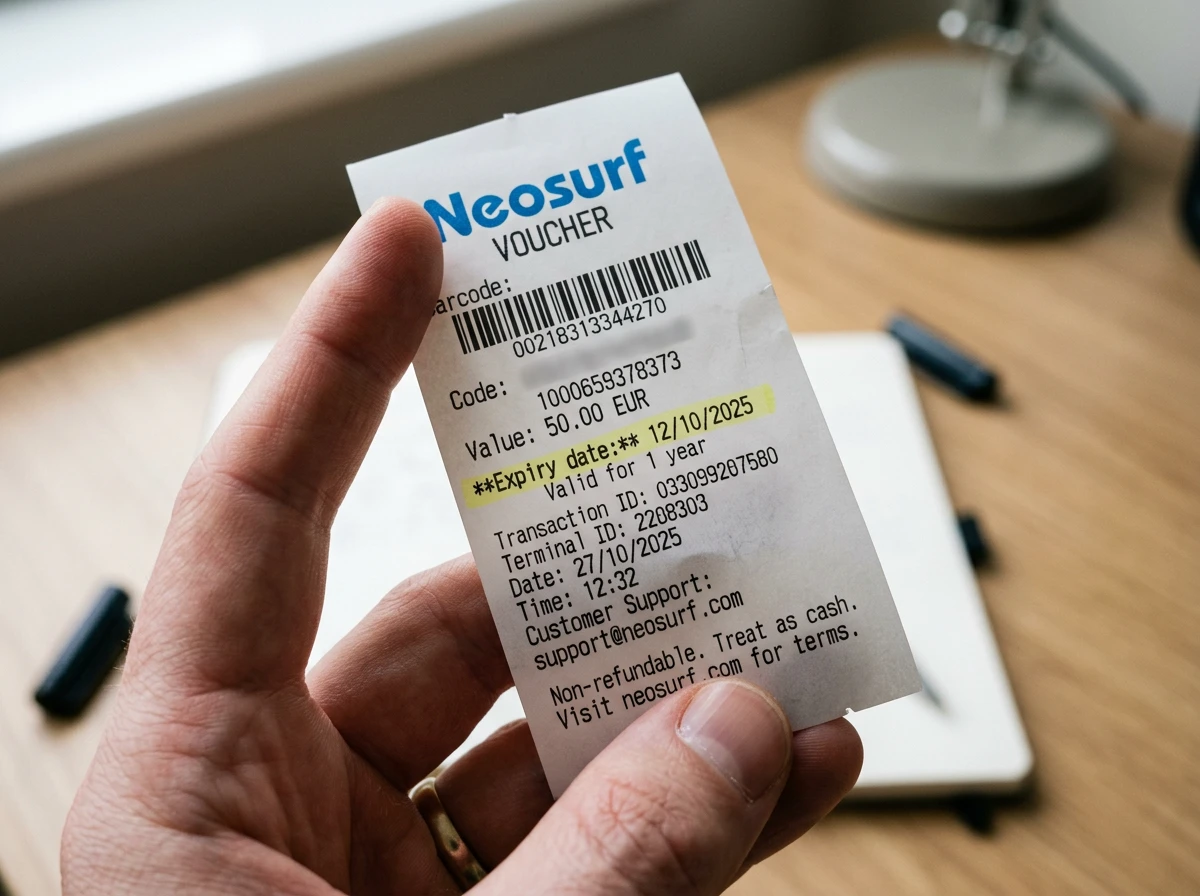
The receipt in your drawer is a clock, not a voucher
A mate rang me last year asking whether he could still use a Neosurf voucher he’d bought for “that Cup thing” — which turned out to be the previous year’s Melbourne Cup. The voucher had sat in his wallet for fourteen months. I told him to go try it and report back. He tried it. It was dead. A$50 gone, no way to reverse it, no refund path at the bookmaker because the bookmaker never saw the deposit. The expiry date on that thermal receipt had quietly ticked past, and nobody sent him a reminder.
That’s the thing about voucher expiry. It doesn’t make noise. There’s no alert on your phone, no email, no letter. The PIN simply stops working, and if you’ve forgotten about the voucher, you find out by rejection at the cashier page. Understanding exactly how long your code is valid — and what erosion can happen before it formally expires — is the cheapest insurance you’ll ever buy against losing money to your own filing system.
The wider context sits in our Neosurf betting guide for Australia.
The standard validity period
A Neosurf voucher sold in Australia carries a 12-month validity from the issue date. That’s the standard. The issue date is printed on the receipt at the moment of purchase, and the expiry lands exactly one year later. Some older batches carried longer windows — 24 months wasn’t unusual a few years ago — but the current standard across the AU retail network is 12 months.
The validity is measured from retail purchase, not from first use. A partially-used voucher — one where you’ve deposited A$30 of a A$50 face value and left A$20 in residual balance — inherits the same expiry date as the original purchase. You don’t reset the clock by using part of the value. Partial balances run out with the parent voucher.
Within the 12 months, the full face value is available for deposit at any Neosurf-accepting site. No degradation, no partial-period rules, no tiered conditions. The voucher works cleanly right up to the expiry date. That’s the simple part — the part people tend to remember.
Dormancy fees: the erosion you didn’t read about
Here’s where the surprises live. If a voucher sits unused for an extended period, Neosurf applies a dormancy fee against the balance. The mechanism is a monthly deduction that starts after a defined idle period and continues until either the voucher is redeemed or the balance reaches zero.
The typical trigger in the AU market is six months of non-use. From month seven onward, a small monthly fee — in the order of a few Australian dollars — gets deducted from the face value. A A$50 voucher bought in January and still untouched in July starts losing its face value silently. By the time the 12-month expiry hits, a portion of that original A$50 may already have evaporated into dormancy charges before the voucher formally dies.
This catches casual punters who buy vouchers “ahead of time” for events that then get postponed or forgotten. It also catches people who buy a voucher, use it partially, and leave the remainder sitting in the voucher for an eventual second deposit that never happens. The residue earns nothing and loses value month by month. My rule is to use a voucher within 60 days of purchase or consolidate the remainder into a myNeosurf wallet where the fee structure is different — though not automatically better, and the full picture of what can be recovered from an expired or exhausted voucher is worth reading before you count on any salvage path.
How to check the expiry on the receipt
The expiry date is printed on the Neosurf receipt, usually near the bottom. The format varies slightly by retailer POS — some print DD/MM/YYYY, some MM/DD/YYYY, some write “Expires” with a longhand date. Look for the line that pairs an issue date with an expiry date; the gap will be twelve months.
If the receipt is faded or the thermal printing has worn — thermal paper degrades in warm or humid conditions — the expiry line is often the first to go. I’ve pulled receipts out of glove compartments after six months of summer storage and found the amount still visible but the expiry unreadable. At that point you’re relying on the issue date and the 12-month default rule, which usually holds but offers no certainty if Neosurf changed the terms for a specific batch.
A safer habit: photograph the receipt within minutes of purchase, storing the image in a secure location offline. If the physical receipt degrades, the photo preserves the expiry record. I don’t recommend photographing the PIN — that’s a separate security problem — but photographing the issue and expiry fields while covering the PIN with a finger or sticky note is a reasonable compromise.
Using the voucher before the last week
Don’t leave a voucher redemption to the last week of its validity. The main reason is not bookmaker processing time — that’s usually instant — but the minor risk of any retailer-side or Neosurf-side delay during that redemption. I’ve seen rare cases where a PIN entered on the expiry day itself triggered an “unknown voucher” error because of a timing mismatch between the bookmaker’s session clock and Neosurf’s backend.
Beyond the edge cases, there’s a simpler argument. A voucher that’s three weeks from expiry is a voucher you need to plan around. Do you have a match or race coming up that justifies depositing the full balance? If not, you’re either depositing into a sportsbook that then holds the balance unused, or you’re letting the voucher expire. Neither outcome is ideal.
My rule of thumb: if a voucher reaches two months from expiry and I don’t have a concrete use in the next six weeks, I deposit it into a sportsbook I use regularly and treat the balance as available bankroll for the next round or race I’d bet on anyway. That converts the voucher’s hard expiry clock into a sportsbook’s soft balance, which typically has no equivalent deadline.
If the code lapses, see refunding an expired voucher.
If the voucher has already expired
An expired voucher is harder to recover than an unused but still-valid one. The PIN no longer redeems at bookmaker cashiers — the sportsbook receives an error from Neosurf’s backend and rejects the deposit. From there, your only route is Neosurf customer support, and the outcomes I’ve seen vary widely.
Best case: if the expiry is recent — weeks rather than months — and you have clear proof of purchase with an intact receipt, Neosurf support will sometimes accept a one-off reinstatement request. This is discretionary, not guaranteed, and slower than most users expect. Document everything, be patient, and don’t assume a fast resolution.
Middle case: vouchers more than a few months past expiry, or where the dormancy fees have already reduced the balance toward zero, become progressively harder to reinstate. Support will confirm the expiration but offer limited remediation. The residual value, if any, may be partially recoverable to a myNeosurf wallet, but the effort-to-reward ratio is often unfavourable for small-value vouchers.
Worst case: a voucher that’s been expired for more than a year, or one where the receipt is lost, is effectively gone. The PIN remains on Neosurf’s system — it’s not magically deleted — but the claim process without documentation reaches a practical dead end. The honest framing is that an expired, undocumented voucher should be treated as a sunk cost rather than a recovery project.
Can an expired Neosurf voucher be reactivated at an AU bookmaker?
Not at the bookmaker side. The sportsbook’s payment gateway checks with Neosurf’s backend and receives a rejection for any expired PIN. Reactivation, if it’s possible at all, goes through Neosurf customer support with proof of purchase, and the outcome is at their discretion. The recent the expiry and the better the documentation, the better your odds.
Does Neosurf charge monthly fees on unused voucher balance?
Yes, after an initial idle period. Dormancy fees typically begin after six months of non-use and deduct a small monthly amount from the face value until either redemption or zero balance. A voucher bought and then forgotten for a year can lose meaningful value to dormancy charges even before the formal 12-month expiry.
