
Neosurf Rollover Rules at AU Bookmakers: How Turnover Conditions Work
 Available in US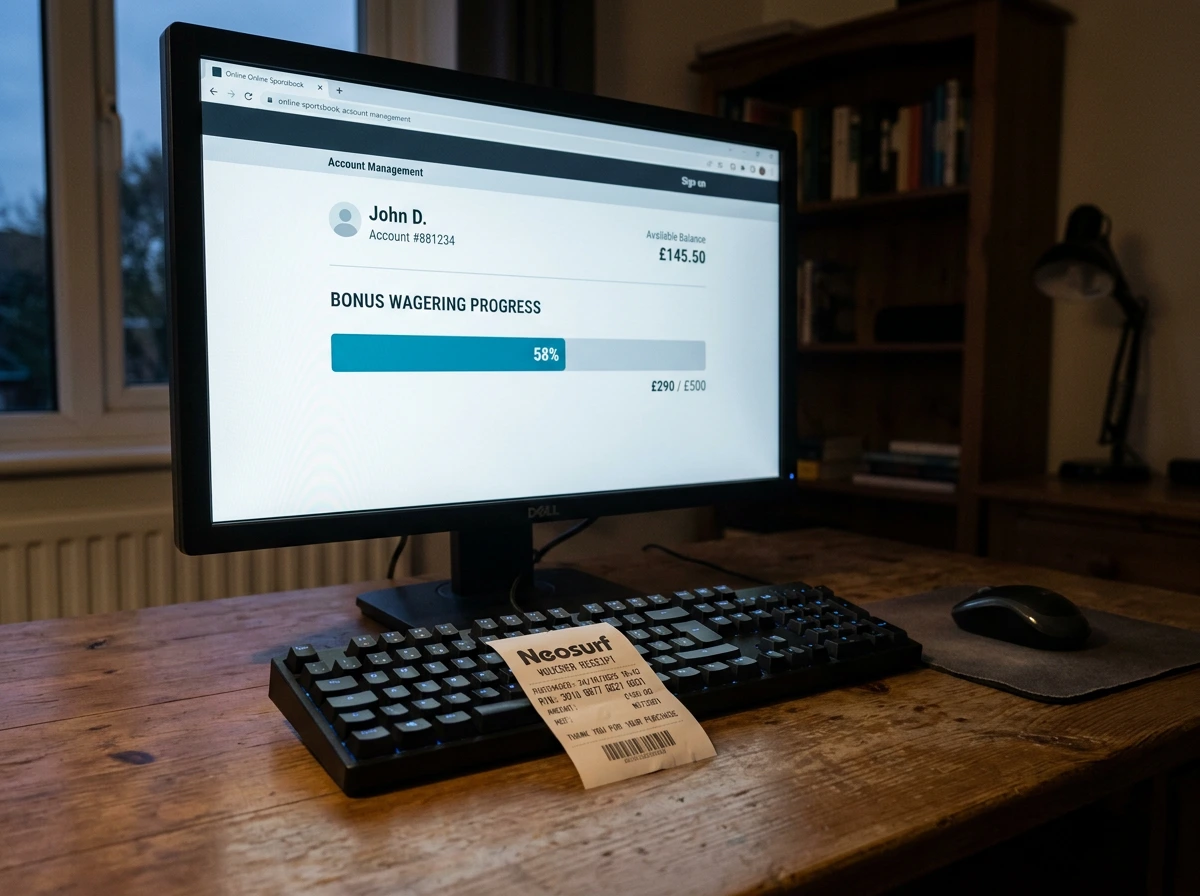
The trap is the clause you didn’t read
A friend deposited A$100 through Neosurf, won A$240 on a weekend NRL multi, and tried to withdraw A$300. The sportsbook rejected the withdrawal request with a single line of explanation: “deposit has not met turnover requirement.” He’d never touched a bonus offer. He hadn’t claimed a welcome match. His deposit — straight Neosurf voucher, no promotional strings visible — had still triggered a 3x rollover before the balance could leave the account. He had to place another A$300 of bets before seeing any of his winnings.
That’s the core surprise of rollover rules on Neosurf deposits. Most punters associate “wagering requirements” with bonus money, not their own money. But at a meaningful minority of AU sportsbooks, prepaid-voucher deposits carry turnover conditions that behave as if they were bonus funds — either as a default operator policy or as a fraud-prevention measure for cash-origin instruments. If you’re depositing Neosurf and planning to withdraw winnings promptly, the rollover clause is the clause that bites.
The wider context sits in our Neosurf betting guide for Australia.
What rollover actually means
Rollover — also called wagering requirement, turnover condition, or play-through — is a rule that says you must place a certain cumulative volume of bets before a deposit or its associated winnings can be withdrawn. A 3x rollover on a A$50 deposit means you need to have wagered A$150 in total stakes across any qualifying bets before the withdrawal option unlocks.
The key nuance: stakes, not settled bets. If you place a A$50 bet and it wins, the returned A$100 is a fresh balance, but the A$50 originally staked counts toward rollover. Place another A$50 bet from the new balance, and you’re at A$100 of A$150 required. One more A$50 stake and you’ve cleared the rollover — regardless of whether those bets won or lost.
That last point matters practically. Rollover is neutral on outcomes; it just demands volume. A punter who places three A$50 bets and loses all three has cleared the rollover — they just have no balance left to withdraw. A punter who places one A$150 bet and wins has also cleared the rollover, with a much larger balance to withdraw. Rollover rewards volume, not success.
Neosurf-specific turnover examples
Pinnacle’s public policy sets a 3x rollover on Neosurf deposits as part of its standard framework. The operator absorbs Neosurf transaction fees, which is a favourable fee position, but couples that with a turnover requirement that has to be met before withdrawal. I mention it because the terms are publicly documented, which makes it a clean reference point even for users who bet with different operators.
Among AU-licensed sportsbooks, Neosurf-specific rollover clauses cluster around 1x to 3x the deposit value. 1x is essentially a single-use-of-deposit rule — you need to bet through the deposit once before withdrawing, which is common and relatively painless. 3x is more demanding, requiring three times the deposit in cumulative stakes, which is the threshold where a small initial balance can feel locked in for several sessions.
Higher multiples — 5x, 10x — are rare for plain Neosurf deposits without an associated bonus. If you’re seeing those numbers, a bonus has typically been applied, sometimes automatically, and the rollover is attached to the bonus component, not the deposit itself. Read the T&Cs for any active promotions before you assume the headline rollover applies to your straight voucher deposit.
Minimum-odds restrictions
A frequent companion to rollover is a minimum-odds rule: only bets at odds above a specified threshold contribute toward turnover. Common thresholds are 1.50 or 1.80. A bet placed at 1.20 on a heavy favourite might technically be allowed, but wouldn’t count toward clearing the rollover.
The rationale is to prevent punters from clearing rollover by cycling the balance through a series of near-certain bets — 1.05 on huge favourites — that minimise loss while technically racking up turnover. From the operator’s perspective, the minimum-odds rule ensures any bet counted as rollover progress carries meaningful risk. From the punter’s perspective, it means you need to engage with real betting markets rather than game the system.
The minimum-odds threshold affects how fast you can sensibly clear rollover on a small balance. If the rule is 1.80 and you’ve got A$50 to churn through A$150 of turnover, you’re placing three A$50 bets at odds between 1.80 and, say, 2.50 — each of which carries a 40-55% chance of losing the whole stake. The expected drawdown while clearing rollover is non-trivial, and that’s the point.
Time limits on rollover
Rollover clauses often carry a time window within which the turnover must be completed. Seven days is common. Fourteen or thirty days less common but not rare. If you don’t clear the rollover in the window, the rules on what happens vary: some operators forfeit the associated winnings, some allow withdrawal of only the original deposit minus any losses, some extend the window on request.
The time limit is another reason to read the specific T&Cs before depositing. A 7-day window on a Neosurf deposit placed on a Monday means you need to have completed all qualifying turnover by the following Monday. If you deposited on Thursday and won big on Saturday, you’ve got 48 hours to churn through the rollover before the window closes — a stressful cadence that doesn’t match the relaxed rhythm most voucher users prefer.
My rule: never deposit Neosurf at an operator whose turnover window is shorter than my planned betting cadence. If I bet once a week and the operator requires a 3x clearance in seven days, that’s mathematically incompatible with my actual behaviour. Either change the behaviour or change the operator.
These conditions arrive with welcome bonuses.
How to check before depositing
The information you need lives in two places: the sportsbook’s general T&Cs (usually under “Deposits” or “Payments”) and the Neosurf-specific deposit FAQ if one exists. Search both for “rollover,” “wagering requirement,” “turnover,” “play-through.” Any of those words turning up in connection with Neosurf deposits means a condition applies.
If you find nothing — no mention of rollover attached to Neosurf or to deposits generally — that’s usually reliable confirmation that no default rollover exists on the straight deposit. Bonus-specific rollovers may still apply if you opt into a promo, but the deposit itself travels freely. That’s the preferred setup for voucher users who value withdrawal speed.
The broader bonus-landscape at AU sportsbooks — including which operators run Neosurf-friendly welcome matches, which attach rollover conditions, and what the T&C red flags look like — is worth understanding in tandem. A separate walkthrough covers what to check in any Neosurf-tied welcome or reload offer before you accept the terms, and that piece pairs naturally with the rollover question here.
Gambling-policy researchers have pushed back on the assumption that current AU consumer protections go far enough. Lauren Levin framed it bluntly in recent commentary: This government does a lot of bragging about everything it has done for gambling consumer protection, but those measures were only ever designed to be first steps.
That perspective matters here because rollover clauses buried in T&Cs are exactly the kind of operator-side friction that existing rules don’t fully address. Reading the fine print is, in practical terms, still on the punter.
Do all AU bookmakers apply rollover to Neosurf deposits without a bonus?
No, and in fact the majority of licensed AU sportsbooks don’t apply default rollover to plain Neosurf deposits. A meaningful minority do, typically at 1x to 3x the deposit value. Pinnacle is a publicly documented example of a 3x rollover on Neosurf. The practical step is always the same: read the deposit T&Cs at your specific operator before committing.
Can a 3x rollover be met on a single horse-racing multi?
Only if the multi’s stake plus the settled returns are cycled appropriately. A single A$150 stake on a multi does clear a 3x rollover on a A$50 deposit — the turnover is counted at stake size, not deposit size — provided the odds meet any minimum-odds threshold. Most operators set that threshold at 1.50 or 1.80, so a multi with qualifying odds per leg clears it; an each-way bet on short-priced favourites typically doesn’t.
