
Neosurf Voucher Denominations and Limits in Australia
 Available in US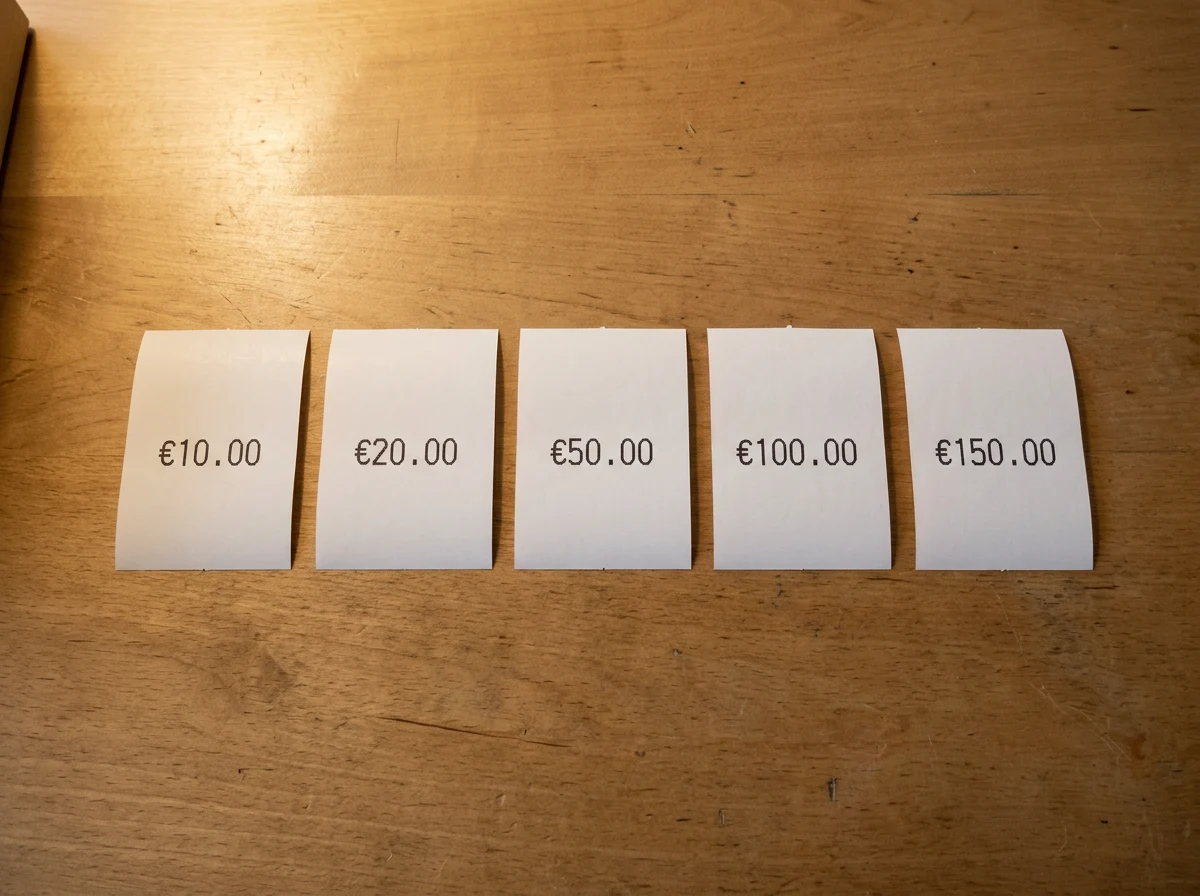
Why denomination is a strategic choice, not a shopping detail
A punter once asked me whether he should buy one A$100 voucher or two A$50s for the same Saturday NRL round. The honest answer is that it’s not a packaging preference – it’s a bankroll decision with real consequences for fees, pacing, and how quickly you burn through a session. Denomination is where the story of a Neosurf deposit actually starts.
Voucher face values are not random. They mirror the minimum-deposit floor most Australian licensed bookmakers enforce – A$10 – and stop at levels that keep cash purchases under AUSTRAC reporting thresholds. The grid in between is designed to cover typical AU wagering sessions without forcing the user into uncomfortable round-trips to the register.
The wider context sits in our Neosurf betting guide for Australia.
The standard denominations you’ll see in AU retail
Walk into any NAR-listed newsagent and the menu on the POS will show five numbers: A$10, A$20, A$30, A$50, A$100. That’s the stable set. Some terminals display higher tiers – A$150, A$200, A$250, A$500 – but availability thins out the higher you go. The A$500 voucher exists in the system and is occasionally offered, but in practice I’ve had retailers tell me it’s “not set up on this terminal” more often than not.
The lower end is where most casual deposits happen. A$10 matches the minimum deposit at regulated AU sportsbooks, A$20 covers a weeknight with two modest punts, A$50 handles a typical race meet, and A$100 is the comfortable ceiling for most weekend bankrolls. When I’m advising friends starting out, I steer them toward A$20 or A$50 first, not A$10 – not because A$10 doesn’t work, but because a single A$10 deposit rarely gives enough room to breathe if the odds go against the first bet.
Above A$100 the maths shifts. You’re less likely to find those tiers at a random corner store, more likely to be asked for ID under AUSTRAC procedures for higher-value cash transactions, and more likely to hit a per-transaction retailer cap that pushes you into buying two or three vouchers instead. The middle band is where the product feels frictionless.
Why A$10 is the floor, and what that number signals
The A$10 voucher is not a starter product or a trial run. It is the minimum functional unit of Australian online wagering – the face value calibrated precisely to match what a licensed bookmaker will accept as a single top-up. Below that, the deposit gets rejected; above that, you’re just paying more than you need to for the same access.
I think of A$10 as the “one single bet” voucher. It covers exactly one punt at modest stakes, which is sometimes all you want – a match multi, a head-to-head at the opening of the Brownlow round, a last-minute NRL line. The floor matters because it lets prepaid work as a micro-instrument, not a lump-sum commitment. That’s genuinely useful if you’re pacing yourself.
The catch I see regularly: A$10 is below the welcome-bonus threshold at most AU bookmakers. Bonuses typically kick in at A$20 or A$50 minimum deposits, so anyone trying to unlock a first-deposit match with a single A$10 voucher will find they’ve cleared the deposit but not the promotion. If a bonus is part of your plan, budget the next tier up.
The upper cap and the multi-voucher question
Single-voucher purchases above A$500 don’t exist in the AU retail network. That’s an upstream design decision by Neosurf tied to anti-money-laundering controls on cash-origin instruments. When a punter needs more than A$500 in a single session – rare, but it happens around Melbourne Cup or State of Origin – the answer is multiple vouchers, not one larger one.
Combining vouchers at deposit time is its own small discipline with mechanics that vary by bookmaker. Some sportsbooks let you enter PINs back-to-back in the same deposit flow; others force you to complete one transaction, then start another; a few funnel you through a myNeosurf account for consolidation. The practical mechanics of stacking two or three vouchers into a single deposit are worth reading before you find yourself at the register buying four A$100s on a Saturday afternoon.
A related trap: retailers may decline to sell you three A$100 vouchers in one transaction. Not because of a Neosurf rule, but because their own POS script flags high-value cash purchases for manual review. I’ve had a 7-Eleven clerk happily sell me two A$100 vouchers, pause at the third, and ask for ID – not a bad outcome, just something to anticipate if you’re loading up for a big weekend.
Denomination versus bookmaker minimum deposit
Here’s a detail the product pages don’t spell out: the voucher face value doesn’t always equal the deposit that lands in your account. If a bookmaker’s minimum deposit is A$20 and you use an A$10 voucher, the transaction gets rejected. If you use an A$30 voucher against an A$20 minimum, the full A$30 lands. If you use an A$50 voucher against an A$20 minimum and only want A$20 in the account, you can’t partial-redeem at the bookmaker side – the full A$50 goes in.
That asymmetry matters for users who buy vouchers as a pre-commitment tool. If you want to cap yourself at A$20 this week, an A$20 voucher gives you exactly that; an A$50 voucher doesn’t, because it pushes more into the sportsbook balance than you intended. I tell people who are using voucher face value as a hard spending limit to buy the denomination they want to spend, not a bigger one “with margin”.
The reverse case is slightly different. Vouchers above most bookmaker maximums – say an A$500 voucher against an A$2 000 per-transaction cap – go in cleanly. There’s no upper friction on the bookmaker side for the retail tier. The only real ceiling you’ll hit is the sportsbook’s daily or monthly deposit cap, and that’s independent of Neosurf.
The smallest option is examined in the A$10 voucher.
Bankroll planning with the denomination grid
The simplest mental model I use, and recommend: pick the voucher size that matches your planned total session, not your planned single bet. If your Saturday plan is four NRL head-to-heads at A$10 each, buy one A$50 voucher, not four A$10s. You save yourself three trips to the register, and the bookmaker balance doesn’t keep resetting to zero between bets.
For weekly punters who place one or two small bets a week, an A$20 monthly voucher is often enough and keeps the habit bounded. For matchday-only users – the ones who only punt during major events – A$100 handled once every few weeks tends to match actual behaviour better than smaller, more frequent vouchers. Big-event users, the Melbourne Cup and State of Origin crowd, often find two A$100s or a single A$200 covers the day comfortably.
The pattern to avoid is the drip: buying a fresh A$10 voucher every second day. That’s behaviour that usually signals loss-chasing, and the cumulative retail friction alone – four trips a week, four receipts to track – is a quiet warning sign. If you notice that rhythm forming, step back. The denomination grid is there to help you plan ahead, not paper over an escalating session pattern.
What is the largest Neosurf voucher I can buy in one go in Australia?
The highest single-voucher face value in the AU retail network is A$500, though A$150, A$200 and A$250 are more commonly stocked at the upper end. Many terminals cap available denominations at A$100 or A$250 depending on the retailer’s NAR configuration. For deposits above A$500, you’ll need to combine multiple vouchers or use a myNeosurf account.
Are custom voucher amounts like A$37 available?
No. Neosurf vouchers are sold in fixed denominations only – A$10, A$20, A$30, A$50, A$100, and the higher tiers. You cannot specify an arbitrary amount at the register. If your target deposit doesn’t match a face value, most punters either round down to the nearest denomination or combine two smaller vouchers.
